


经济新闻
光伏低迷下储能取代组件成SNEC展会焦点 2026-06-08
China's photovoltaic industry is accelerating its shift toward energy storage as prolonged losses caused by oversupply and falling module prices force manufacturers to seek new growth engines.
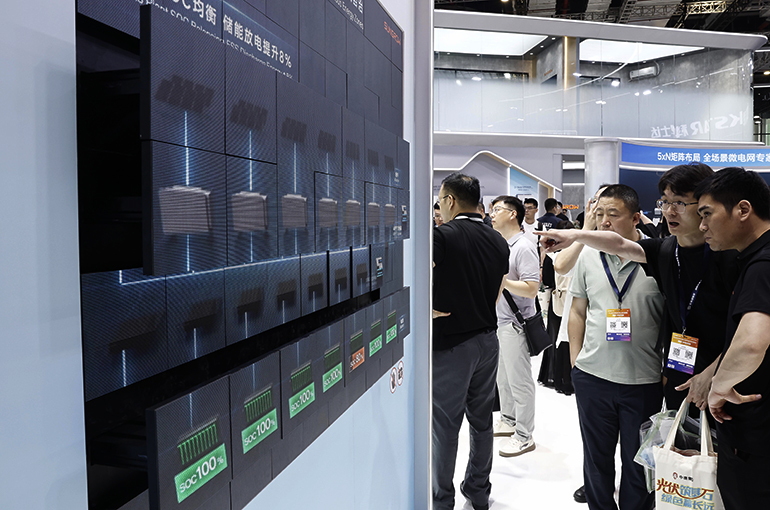
The transition was evident at the 19th International Photovoltaic Power Generation and Smart Energy Conference & Exhibition (SNEC), where energy storage emerged as the dominant theme. This year's event featured six energy storage pavilions and four photovoltaic-related pavilions, marking the first time that storage exhibition space exceeded that of PV.
The three-day exhibition in Shanghai last week also highlighted a broader industry shift. Traditional displays centered on solar modules gave way to demonstrations of integrated energy solutions, including "all-scenario solutions" and "zero-carbon parks," reflecting companies' growing emphasis on combining power generation, storage, and energy management.
Industry executives said the move toward solar-storage integration is becoming increasingly important as standalone PV projects face mounting profitability challenges.
China's PV industry has been mired in losses since 2024 because of severe overcapacity and a prolonged decline in module prices. In the first quarter of this year, the world's five largest PV module manufacturers by shipment volume -- Jinko Solar Holding, Longi Green Energy Technology, Trina Solar, JA Solar Technology, and Tongwei -- all remained in the red, extending losses from last year.
Energy Storage Becomes the New Growth Engine
In contrast, some PV firms with significant exposure to energy storage, including Sungrow Power Supply and CSI Solar, have maintained stable profitability during the industry downturn.
"Over the past 20 years, China's photovoltaic industry has completed the first phase of making solar power affordable," Longi founder Li Zhenguo said at the company's exhibition booth. "The next 10 years will be about making solar and energy storage the main sources of electricity."
"Cheap electricity has a 'ceiling' on its value if it cannot be reliably fed into the grid and used flexibly. Achieving this requires a complete technological system and ecological capabilities," Li added.
At this year's exhibition, Longi unveiled an integrated solar-storage solution spanning PV cells to energy storage systems. Compared with conventional assembled systems, the company's native integrated solution can raise project internal rates of return by 2 to 4 percentage points, Vice President She Haifeng told Yicai.
Jinko Solar also introduced its next-generation energy storage system, SunTera G5. As the economic benefits of solar-storage projects become increasingly apparent, demand from energy storage customers continues to grow, according to Vice President Dany Qian.
The company has secured about 5 gigawatt-hours of energy storage orders so far this year and has more than 20 GWh of orders in reserve. Total energy storage shipments this year are expected to double from last year's level, Qian said.
China's PV industry is approaching a critical turning point as it shifts from rapid capacity expansion to high-quality development, Zhu Gongshan, chairman of GCL Group, said at SNEC's opening ceremony on June 2.
In the future, standalone PV manufacturers may gradually disappear and be replaced by new business models such as digital energy asset operators, zero-carbon solution providers, and artificial intelligence-powered energy technology service companies, Zhu said.
来源:Yicai Global
