



经济新闻
中国AgiBot公司下线第15000台人形机器人,并完成现场平板质量检测测试 2026-06-29
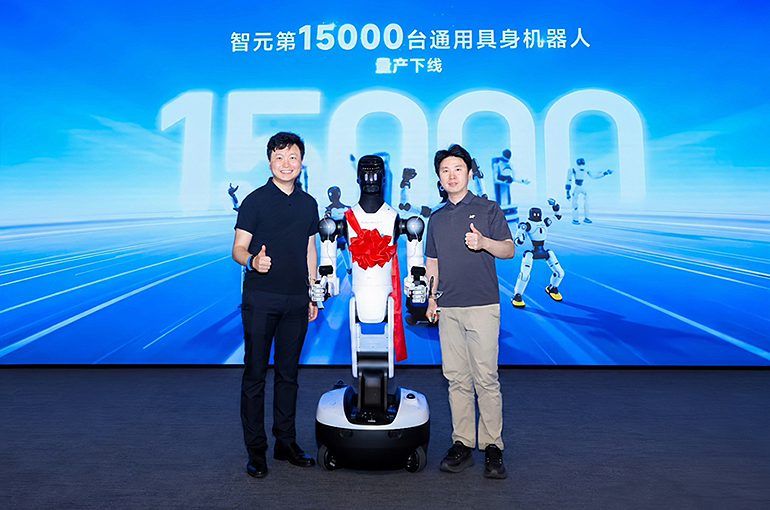
Chinese humanoid robotics startup AgiBot has delivered its 15,000th unit less than three months after selling its 10,000th unit, while also concluding its six-day livestream test of eight Genie G2 robots performing tablet quality inspections at a factory of Longcheer Technology in Nanchang, China's Jiangxi province.
"Shipping out the 15,000th robot marks a new milestone in mass production and shows China's humanoid robotics industry is moving into large-scale deployment in real-world applications," Yao Maoqing, a partner at AgiBot and president of the firm's embodied intelligence business, said last Sunday.
Established in February 2023, AgiBot sold its 10,000th humanoid robot in March this year. In addition, the Shanghai-based company delivered 5,168 units last year to take 39 percent of the global market, ranking first worldwide in both, according to market research firm Omdia.
"Most of my day is spent coordinating deliveries, supply assurance, quality control, and engineering changes," Yao said amid the increased pressure on the supply chain from the rapid expansion. A quality engineer was stationed at a supplier's factory producing a key component used in the Genie G2 for more than three months, helping boost production capacity fivefold while raising the first-pass yield to over 95 percent from less than 60 percent, he pointed out.
AgiBot has set up a standardized supply chain covering the entire upstream and downstream ecosystem in the Yangtze River Delta, with more than 70 percent of its components sourced from the region, the company said.
Genie G2 Livestream Test
The livestream was intended to put the Genie G2 to the test on an active production line under public scrutiny. Longcheer Tech is an original design manufacturer that counts Xiaomi, Samsung Electronics, and Lenovo among its clients.
The Genie G2 robots worked from 8 a.m. to 7 p.m., in line with the factory's production schedule, picking tablets from conveyor belts and inserting them into precision testing equipment at final inspection stations to sort qualified and defective products before shipment. After inspecting more than 17,000 tablets, they had a success rate of 99.99 percent.
Since last December, the Genie G2 robots have been operating on a secondary production line of Longcheer Tech before being integrated into the main one in March.
However, the livestream was not without setbacks, with one robot experiencing a communication failure with the testing equipment early on, interrupting the inspection cycle and causing two tablets to stack together, which required manual intervention and led to the success rate temporarily dropping to about 99.96 percent. The robot immediately reported the fault, switched to another station, and resumed operation about two minutes later without substantially affecting overall production.
"I hope every problem shows up during the livestream, because every issue we uncover brings us one step closer to large-scale deployment," said Li Long, general manager of the robotics business department at Longcheer Tech.
The livestream was shown across multiple domestic and overseas platforms. Some overseas viewers compared it with Figure AI's earlier 200-hour warehouse-sorting live, but argued that operating on an active third-party production line presents far more variables.
During the days after the robots entered Longcheer Tech's secondary production line, their March deployment, and the livestream, the joint team of AgiBot and the client identified and resolved about 60 issues, ranging from sensor errors that caused robots to collide to communication protocol mismatches that resulted in lost commands.
Ensuring Robots Pay Off for Clients
Following mass production, making sure the robots operate stably at customer sites has become AgiBot's next challenge.
"Robots need to match the pace of human workers while maintaining a very high level of reliability. That's the key problem we still need to solve," Li stressed. Their artificial intelligence systems have not yet reached the point where they can learn a new task simply by observing it once, with every new application still requiring pre-training and post-training by algorithm engineers, Li noted.
Robots also operate as part of a broader production system involving dozens of workers, meaning a single malfunction can disrupt an entire production line, Li pointed out.
AgiBot's goal is to achieve a "deployment-ready" state, where robots can be put to work immediately rather than serving as development platforms, Yao said. "Like buying a car, you should be able to start using it right away."
To shorten the gap between manufacturing and deployment, AgiBot is advancing on building an ecosystem of partners by offering training programs that enable developers to maintain and debug robots independently and refining its software toolchain.
AgiBot has launched Genie Studio Agent, an agent development platform enabling partners to build customized applications and integrate robots into customer operations more easily while lowering deployment barriers.
Orders from manufacturing customers are shifting from pilot projects to bulk procurement, AgiBot noted, adding that it expects to deliver more than 1,000 robots in the areas of semiconductor manufacturing, auto components, logistics and warehousing, and commercial services by the end of this year.
In March, AgiBot's humanoid robots were deployed at the production line of batteries for the Buick Electra E7 at SAIC-GM's Ultium plant, performing high-precision operations with positioning accuracy of plus or minus 0.1 millimeters. This was the first android used by Chinese carmaker SAIC Motor in a mass-production line and among the first in China's auto industry.
At Beyond Expo held in May, AgiBot said it is continuing to expand overseas. Relevant revenue accounted for less than 10 percent of the total last year but approached 20 percent in the first half of this year, with North America, Europe, Japan, and South Korea being the company's primary target markets.
Global demand for humanoid robots could reach about 86 million units by 2050, creating a market worth between USD1.4 trillion and USD1.7 trillion, according to UBS.
However, the industry's "electric vehicle moment," or when annual sales jump from millions to tens of millions of units within a short period, is unlikely to arrive before 2030, due to immature AI capabilities, insufficient training data, and a lack of regulatory frameworks, said Phyllis Wang, machinery analyst at UBS.
Source: Yicai Global
