



今日上海
西门子医疗扩大在华研发 - 2026年11月05日
Siemens Healthineers ups China R&D
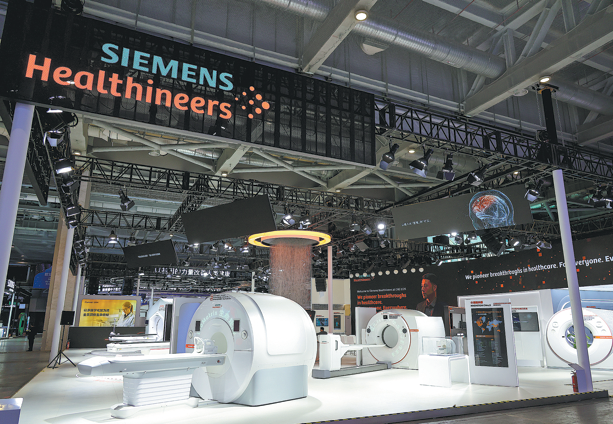
German medical technology company Siemens Healthineers is expanding research and manufacturing in China, with the aim of strengthening local development of high-end equipment and core components, and supplying domestic and global markets, a senior executive said.
Jerry Wang, president of Siemens Healthineers Greater China and member of Siemens Healthineers Global Leadership Committee, outlined the company's priorities in an interview with China Daily ahead of the 9th China International Import Expo, which opens on Thursday in Shanghai.
"In the past, our investments in China were primarily focused on market expansion, product introduction and local manufacturing," Wang said. "Looking ahead to the 15th Five-Year Plan period (2026-30), our investment strategy is evolving further toward 'innovating in China, manufacturing in China, and serving the world'."

The company expects its new high-end medical equipment research and development and manufacturing base in Shenzhen, Guangdong province, to begin operations in 2027. It has also started expanding its core component manufacturing base in Wuxi, Jiangsu province.
The Wuxi expansion, launched in July, involves more than 100 million yuan ($15 million) in investment and will focus on developing and producing X-ray tubes and high-voltage generators for high-end computerized tomography, or CT, scanners and angiography systems. More than 60 percent of the existing site's products are exported, according to the company.
The company already operates six R&D and manufacturing bases and two innovation centers in China. It says it has manufactured more than 160 products locally, with its China-made portfolio reaching more than 150 countries and regions worldwide.
Stephen Sunderland, head of Asia-Pacific at L.E.K. Consulting, told a Beijing forum on cooperation between Chinese and international medical technology companies in June that companies were increasingly recognizing China's contribution to innovation and its potential relevance to their global product portfolios.
Wang attributed the continued investment to long-term healthcare demand in the world's second-largest economy, including an aging society, growing public health awareness and an increasing burden of chronic and age-related illnesses such as cancer and cardiovascular diseases.
The national health plan for the 15th Five-Year Plan period calls for expanding access to high-quality medical resources at the grassroots level and reducing regional disparities. It also promotes digital and intelligent technologies in areas including assisted diagnosis, precision medicine and health management.
Wang said the company would strengthen its capabilities in imaging, precision therapy and artificial intelligence to help address cardiovascular diseases, cancer, neurodegenerative diseases and strokes. It also plans deeper cooperation with clinical and research institutions to bring technologies into medical practice.
The investment comes in a market where domestic and multinational manufacturers compete for hospital orders. Domestic player United Imaging Healthcare led by unit volume in China's publicly tendered CT procurement in 2025, while Siemens Healthineers held the top position by procurement value, according to an industry report jointly compiled by the National Innovation Center for Advanced Medical Devices and partner institutions.
An example of the German firm's localization drive is its photon-counting CT technology, which it showcased at the fourth China International Import Expo in Shanghai in 2021. Two locally made models received regulatory approval in China in June this year, the company said.
The company has established production of high-end photon-counting CT scanners in China, Wang said. It is also working with Chinese clinical institutions to explore applications in cardiovascular, liver and neurological diseases, including how the technology can support clinical assessment and treatment decisions.
At this year's CIIE — the company's ninth consecutive appearance since the event began in 2018 — Siemens Healthineers is showcasing nearly 20 advanced products and disease-management solutions.
Among them is a system combining photon-counting CT, an angiography system and AI software to support coronary interventions, designed to help doctors use pre-procedure imaging in treatment planning and connect information across departments.
In past editions of the CIIE, the company has exhibited over 200 products, 85 percent of which have been approved for the Chinese market, and 60 percent of which have begun local production.
Wang described the expo as a platform for bringing together technologies, clinical needs and industry resources, helping products reach medical practice.
Looking ahead, Wang emphasized that the company's next phase of investment in China will hinge on local R&D, core component supply and closer cooperation among hospitals, researchers and industry partners.
"This means that our future investments will focus not simply on 'more products', but on building stronger local innovation capabilities and a more complete industry ecosystem," he said.
Source: China Daily
